“Strategy” has been the magic word in business in recent years. No company or marketing department wants to work without a “strategy” these days. Strategy is a must, because the opposite would be ‘strategyless’ and therefore haphazard. In our fast-paced world, that’s a horror scenario. Unfortunately, what many companies and marketing departments see as “strategy” is far from it. Often, it is merely a matter of firing off countless “tactical rockets” or, at best, medium-term campaigns. As a result, marketing departments in particular are almost doomed to fire off new rockets again and again in order to keep the flow of tactical marketing measures going. It’s a vicious circle. But there is a way out.
Simon Sinek: Always start with WHY
With his “Golden Circle” theory, Simon Sinek recognized back in the early 2010s that most companies do not know their own “WHY,” but at the same time, the ‘WHY’ is the reason why customers buy products from companies in the first place. Because: “People don’t buy what you do, they buy why you’re doing it.”.
Simon Sinek:
But very very few people or organisations know why they do what they do. And by why I don’t need to make a profit. That’s a result. It’s always a result. By why I mean what’s your purpose? What’s your cause? What’s your believe? Why does your organisation exist? Why do you get out of the bed in the morning? And why should anyone care? (Quelle: Simon Sinek auf Youtube)
However, the majority of (German?) companies take the opposite approach. Instead of focusing on the “WHY” first, they take the traditional approach of focusing on the products, features, and benefits. Their thinking follows the classic pattern of “advertising” and “promotion.” This leads to marketing departments being downgraded to “advertising departments” that have to fire off one “tactical rocket” after another. Another white paper, another social media post, another webinar, another blog article—the more, the better. Or, to put it another way: enough is never enough, and more is always better! See also the article by Maël Roth: “The thing about lead generation in marketing…”
(Too many) tactical measures inevitably lead to excessive demands:
Many marketing departments still seem to be operating without a plan. Today, many departments are constantly driven and chronically overloaded with tasks. New channels and tactical forms of communication are constantly being introduced and need to be utilized. For employees, this often means not only more stress due to an increasing number of tasks, but also constant stress in monitoring and coordinating those tasks. Keeping track of the to-do list often becomes the most exhausting part of the daily tasks. According to a 2017 study of AOK members, dialogue marketing employees are among the group with the most burnout cases. Where does this external control come from?
My thesis: lack of (core) strategy! Or: No “WHY”!

The focus must always be on the “WHY”:
Simon Sinek’s theory of “the golden circle” provides the perfect starting point for strategic thinking. At the heart of every company and every strategic consideration (especially in marketing) is the “WHY.” Why does a company do what it does? What is the decisive reason for its actions? What is the purpose? What is the company’s vision? Why do we get up every morning?
Unfortunately, it seems that many (German?) companies do not know their “WHY” – or do not even want to know it. There seems to be a certain fear of the “WHY.” Where does this fear of getting to the bottom of the meaning of one’s own actions come from? Fear of greatness? Fear of being accused of megalomania? Fear of childishness? Fear of realizing that generating sales is not a meaningful and strategic goal?
Many of the “WHYs” of large companies read very simply – almost childishly – in terms of wording. It’s about improving the world, making other people happy, or thinking differently and thus being disruptive. And yes, the wording is often very grand and also often kept very simple. It seems that for many German companies, this simplicity is the opposite of professionalism!
The love of data and the desire to squeeze professionalism and daily activities into measurable figures seems to have pushed the (simple) “WHY” far into the background. Yet figures are only the quantitative continuation of the “WHY.”
We forgot the WHY because we were so focused on the numbers:
Assignments contain figures on all kinds of topics. Employees are measured by the number of units sold or revenue generated, but not, for example, by whether they made the customer happy or adhered to the “WHY.” Shouldn’t fulfilling the (strategic) ‘WHY’ always be the top priority in the assignment? Shouldn’t every employee’s every activity be geared toward the “WHY”?
Please don’t misunderstand. Of course, at the end of the day, only hard numbers matter. But it seems that we have lost sight of the soft targets completely in our obsession with hard numbers. Without considering that, when implemented consistently, soft targets contribute perfectly to hard targets. In their love of hard figures, many companies have made the cardinal mistake in controlling and cut all activities that do not directly generate revenue. The problem is that customers do not generate revenue because previous customers have already generated revenue. Customers want to solve a problem or have a problem solved.
The golden pyramid – the 3D model of the “golden circle”:
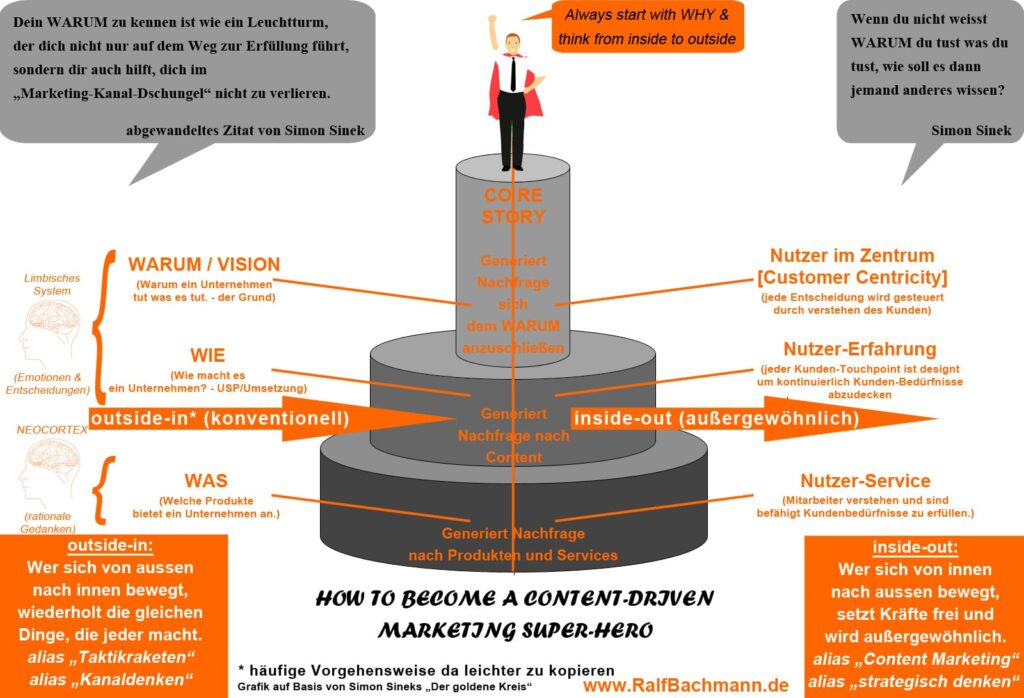
The “golden pyramid” is an attempt to expand Simon Sinek’s “golden circle” into a 3D model. It is not only about the WHY, HOW, and WHAT, but also about understanding and the impact on customers and prospects, as well as the operational processes in many departments.
The fact that the WHY and the HOW affect the area of the brain (namely the limbic system) where decisions are made shows that it is essential to define a WHY for a company. At the same time, it shows that many departments, by proceeding from the outside in, think in a very classic channel-based way and are therefore very conventionally structured. Only those who think from the inside out can break new ground based on the “WHY” and address customers in a targeted manner in the limbic system. This is the only way a company can emerge as a trusted leader in its industry. All in all, this not only strengthens the brand and boosts sales, but also makes the brand less sensitive to market and price fluctuations. Apple can still charge the highest prices for its smartphone, which certainly does not have the best features on the market (sorry, dear Apple fans). Hardly any other product targets the limbic system so directly and thus has such an unwavering fan base as the iPhone..
Do Americans have an easier time with the “WHY”?
One might spontaneously ask whether it is easier for Americans and thus American companies to find a “WHY.” The mindset of the “American dream” with slogans such as “from rags to riches” or “think big” perhaps provides better fertile ground for a big dream and thus a bigger “WHY”. While German companies are experts at improving existing products and delivering world-class quality, US companies see themselves as leaders in their field. Tesla and Apple are not market leaders because their products are the best, but because their brands radiate something special. The more comparable products and their features become (whether B2C or B2B), the more the brand and the emotions associated with it take center stage. If Chinese copycats offer the same quality at half the price, how can I, as a European or American, keep up? With my brand! With my “WHY”.
See also: Brand vs. Sales – warum die Marke und das Image alles ist