
Blog article series – Please No Sales-Calls:
Part 1: The future of the marketing and sales funnel: how strategies need to adapt
“For us, the customer is the focus.” A phrase that is so familiar and often so empty of meaning. In many B2B companies, customer focus ends exactly where internal debate begins: marketing versus sales. Silos instead of synergy. Or even worse: until sales enters the stage and/or the marketing budget is cut. Anyone who continues to view marketing as a reactive supplier of white papers and trade fair flyers is steering their company straight toward the iceberg.
We are currently experiencing radical change. Traditional cold calling is reminiscent of the “sales hell” of the 1990s. As a strategic orchestrator, I believe that those who fail to rethink their approach now will lose touch. After all, first-class services are worthless if the market is unaware of them. Those who operate without a content strategy are steering their company straight toward the iceberg, just like the Titanic. Or even worse, if the sales pitch feels like an intrusive attempt at flirting in a village disco with a blood alcohol level of 2 per mille.
We no longer need a traditional funnel; we need a system that overcomes “digital coldness” and transforms genuine passion into measurable output.
1. The “Day One” trap: Why 92% of deals are decided before the first hello
Forget the myth that quality sells itself. The reality in B2B is tough. The often-repeated assumption that all you need to do is be good and customers will come to you is a dangerous illusion in B2B. The bare figures show a different reality (see study: 6sense, among others):
- The winning bias: 84% of buyers ultimately choose the brand they already had a positive bias (priming) toward before they began their active search.
- The 90% hurdle: 86% of buyers start with a fixed set of known suppliers.
- 92% ultimately buy from one of these “day-one” favorites.
- The shortlist wall: Initial contact with sales only takes place once 70% of the buying journey has already been completed.
Why is that so? B2B decisions are fear-based decisions. Non-technical stakeholders (IT, purchasing, management) in particular shy away from the risk of an unknown provider. If you haven’t established mental availability before the need arises, you have less than a 10% chance of closing the deal. If you only show up when the customer Googles you, you’re already too late.
Conversely, this means that marketing actually has to get involved 5–10 years in advance and work the field for a long time before the search even begins. Keyword: top of mind.
At this point, it is worth reflecting once again on the significance of the figures. Although the values may vary slightly depending on the study/source and specific question, the average picture is clear: sales only reach around 10 to 20 percent of potential customers, while marketing is responsible for addressing the remaining 80 to 90 percent. Nevertheless, especially in times of crisis, marketing budgets are often the first to be cut. And even in good times, marketing is actually constantly underfunded. Why is that?
2. The emancipation of the buyer: The “rep-free experience”
Modern buyers have taken the helm and gone from being “targeted” to “self-finders.” According to Gartner, 61% of B2B buyers want a “rep-free experience”—they want to buy, not be sold to.
- 61% want a “rep-free experience”: they want to complete their purchase themselves without talking to a salesperson.
- The flood of interactions: A European B2B buyer has an average of 620 interactions (content consumption, website visits, reviews) during their journey.
- 73% avoid pushy providers: Anyone who is too pushy is immediately removed from the relevant set.
- 69% complain about inconsistencies: The information on the website and the statements made in sales often do not match. If the website delivers “marketing blah blah” but the sales department speaks a different language, digital coldness ensues.
- The result: As soon as a sales rep becomes too pushy or information is contradictory, the provider is out of the running.
This is where the greatest potential for the silo stopper lies: when marketing and sales don’t tell the same story, digital coldness ensues. But don’t jump to conclusions. Sometimes it’s the other way around, with marketing trying to create high-quality content, but sales playing its own game and completely ignoring its own website as a source – see point 4.
The solution: Your marketing department must therefore take on tasks that used to belong to sales. Building trust through self-service tools, dashboard insights, and transparent pricing structures directly on the site, high-quality content (content marketing), and content delivery across numerous channels in a variety of formats. In other words, the entire marketing spectrum, and much earlier than the customer even thinks about buying.
3. The 95:5 rule: The operational failure of the old inbound model
Or: Why performance marketing alone is a wasted opportunity.
Many companies still rely on the old inbound model: a few blog articles, some SEO, five nurture emails, and then the sales call. That’s no longer enough. The Ehrenberg-Bass Institute shows that 95% of your market is currently not ready to buy. So stop focusing on “easy” performance figures. Or even worse: many companies feel great when they have put a lot of effort into establishing a clean measurement of performance marketing figures. Congratulations, you are currently measuring 5% of your potential market. The rest falls by the wayside.
A few SEO articles are not enough to retain this audience. We need to demonstrate thought leadership on strategic channels (such as LinkedIn or podcasts). Lead nurturing no longer means “email spam,” but rather a lasting, relevant presence. We need to stay top of mind until the 95% switch to the 5% of active buyers. If companies only show up when the customer is actively searching, the seat at the table is often already taken.
A strategic orchestrator reduces complexity to two questions:
- For the 5% (ready to buy): Do you offer self-service tools, dashboard insights, and all the information needed to minimize risk on your website?
- For the 95% (not ready to buy): Are you constantly present on channels such as LinkedIn or through podcasts (the list of channels is almost endless today) to demonstrate thought leadership long before a need arises?
- But it gets worse: the unresponsive make up an average of 23% of buyers in this category. They are the most resistant to marketing efforts, and there are relatively few channels that have been proven to influence them. Despite – or perhaps because of – the challenge of influencing them, these less receptive buyers are a highly coveted market: if you can get them to buy a brand, they are less likely to be poached by a competitor during the active phase. However, if you approach them for the first time during the active phase, the chances of influencing them are slim to none. In other words, performance marketing bounces off this 23% like a tennis ball..
This is precisely where there is a decisive break with performance marketing – both operationally and in terms of mindset. Studies have shown that performance marketing appeals to precisely this 5% of people who are ready to buy. The rest fall by the wayside. A waste of opportunity and budget par excellence. But the opposite is true. Marketing and management must endure the pain of marketing to the 95% who are not ready to buy, but who may become customers at some point. Studies show that this approach works extremely well. For many companies, however, especially SMEs, it is almost impossible to measure this. That is why they tend to go for the “easy” performance marketing figures. This is a fallacy with far-reaching consequences.
4. The silo dilemma: When sales avoids its own website
A critical symptom of a lack of alignment: sales employees are reluctant to send prospective customers the link to their own website. If the “problem mirroring” that sales uses in conversations is missing there, the company loses credibility. But the reverse is also true: if marketing does its homework (high-quality content, personas, technology, etc.), but sales, for various reasons (and yes, even ego reasons), does not direct prospects to the website or does not use the website as a source for “speaking with one voice,” then the system grinds to a halt.
In a Clarity Sprint, these worlds are synchronized. The website must embody the “sales DNA” in order to convince the complex purchasing committee – currently averaging 9.5 people in Europe. Especially when IT is involved (in 83% of cases), content becomes a bridge between departments..
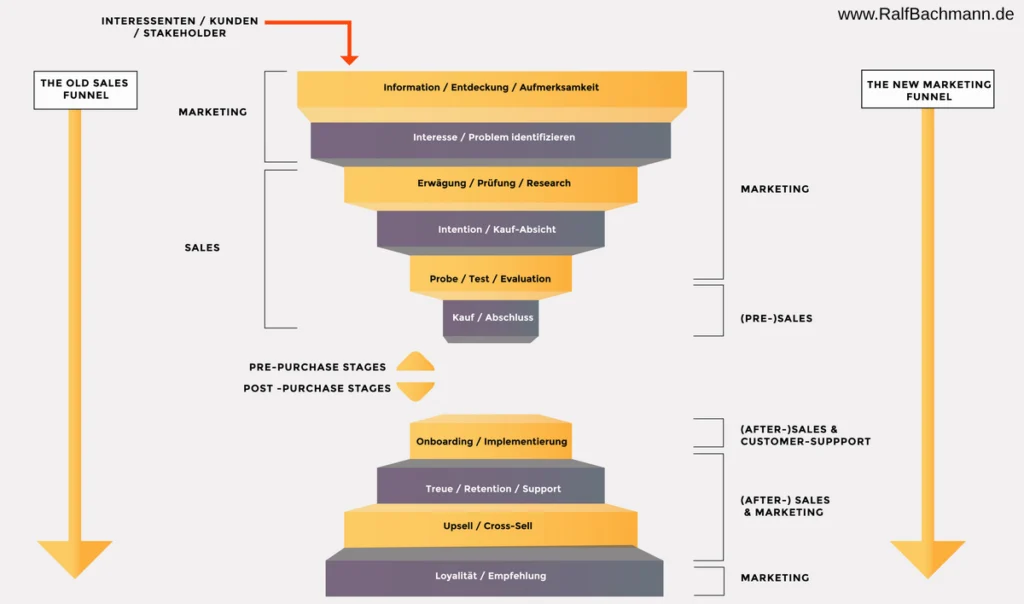
But be careful: “sales DNA” does not mean that marketing has to learn to take orders from sales (keyword: service provider). In fact, it’s exactly the other way around, and this brings us back to the point above. If around 80–90% of purchasing decisions, the customer journey, etc. are made before sales is even let off the leash, then a large part of sales activities shifts towards marketing. Yes, marketing must breathe sales DNA, but only because marketing takes on a large part of the sales tasks. Marketing has no catching up to do. Marketing takes the lead. That is the difference!
Conclusion: Time for a new ranking
The end of image pushers has come. Today, marketing is no longer a reactive supplier (service provider), but rather the strategic leadership that guides sales. Marketing reports directly to management. Companies that tailor their content precisely to this mindset achieve significantly higher profit margins.
Are marketing and sales in your company truly linked in partnership? Those who ignore the “new marketing funnel” are leaving the field open to the “day one” favorites. It’s time to break down the silos and turn genuine passion into an integrated system. And as harsh as it sounds, all the figures point in the direction of marketing.
“The New Marketing Funnel” – Die Aufgaben des Marketings werde immer mehr.
FAQ: The new B2B marketing paradigm
Because the decision has usually already been made before your sales team even picks up the phone. The figures are clear: 86% of buyers start with a fixed set of known suppliers, and 92% end up buying from one of these “day one” favorites. If you haven't established “mental availability” before the need arises, you're fighting against a statistical chance of closing the deal of less than 10%. B2B buying is risk avoidance – and brand awareness creates the necessary trust among all stakeholders.
It means that 61% of B2B buyers prefer to go through the purchasing process completely independently and without contact with sales. Today's customer is a “self-finder.” Marketing must therefore take on tasks that used to belong to sales: building trust through deep insights (dashboards, pricing) and high-quality content directly on the website. Those who force customers into demo appointments just to provide basic information create “digital coldness” and are out of the running.
Performance marketing appeals almost exclusively to the 5% of buyers who are actively searching right now. Those who rely solely on these “easy” figures are ignoring 95% of their potential market. Particularly critical: the approximately 23% of “unresponsive” buyers are completely immune to performance ads. You can only reach them through long-term thought leadership and presence (e.g., LinkedIn, podcasts), long before they enter the active phase. Those who only show up when the search begins are usually already second best.
Through radical alignment, for example in a Clarity Sprint. There must be no disconnect between the website story and the sales pitch (which 69% of buyers complain about today). The goal is a website that exudes “sales DNA” so that the sales department can proudly use it as a central source to convince the complex purchasing committee (9.5 people on average). Alignment here does not mean that marketing is the service provider for sales, but that both speak a consistent language.
Because the balance of power has shifted. With 80–90% of the customer journey now taking place without direct sales contact, marketing is taking on the lion's share of what used to be sales tasks. Marketing is no longer just about pushing images, but is now the strategic authority that guides sales. Companies that place marketing directly under management and optimize it for the 620 digital touchpoints have been shown to achieve up to 20% higher profit margins.

The traditional marketing and sales funnel is changing fundamentally. Companies need to adapt their strategies as customers are increasingly researching and making purchasing decisions on their own. Close dovetailing of marketing and sales (alignment) is essential in order to optimally support the customer journey. Find out how content marketing, data-driven strategies and digital tools are revolutionizing the modern funnel and enabling long-term customer loyalty.