The Fallacy of the Last Five Percent: Where AI Really Comes Into Play
The fundamental flaw in this line of thinking lies in the definition of “craftsmanship.” Of course, AI won’t be laying pipes tomorrow. But the crucial question for the future of our industry isn’t whether an algorithm can physically install a heating system, but rather: What specific steps are actually necessary to achieve this goal—and how many of them can AI take over? When we break down the skilled trades, we find that the actual, final task is often just the tip of the iceberg. A large portion of valuable working time is spent on upstream and accompanying processes. And this is precisely where AI in the skilled trades will make a radical impact in the coming years:
- Smart Planning & Measurements: Image recognition and AI-powered software calculate material requirements and room dimensions in seconds with greater precision than any manual measurement.
- Automated Customer Communication & Order Processing: AI agents handle the entire back office, answer customer inquiries around the clock, and autonomously process orders in the warehouse.
- Inventory Management & Logistics: Proactive, automated workflows optimize supply chains and minimize downtime.
- Not the classic “robots replacing skilled workers,” but rather: inspection drones, sensor technology & predictive maintenance, semi-automated tools, AI-powered diagnostics → Result: One technician does the work of several employees.
- Many tasks in the skilled trades follow recurring patterns: maintenance checks, troubleshooting based on established procedures, diagnostics, planning, procurement of materials, and documentation. In principle, these tasks can be automated—especially in controlled environments (industry, new construction, data centers).
The result? AI is gradually taking over 90 to 95 percent of administrative and planning tasks. In the end, humans are left with only the final five to ten percent—the purely physical execution. But anyone who believes this situation will last is underestimating the pace of technological evolution.
From Algorithm to Matter: When Workflows Become Physical
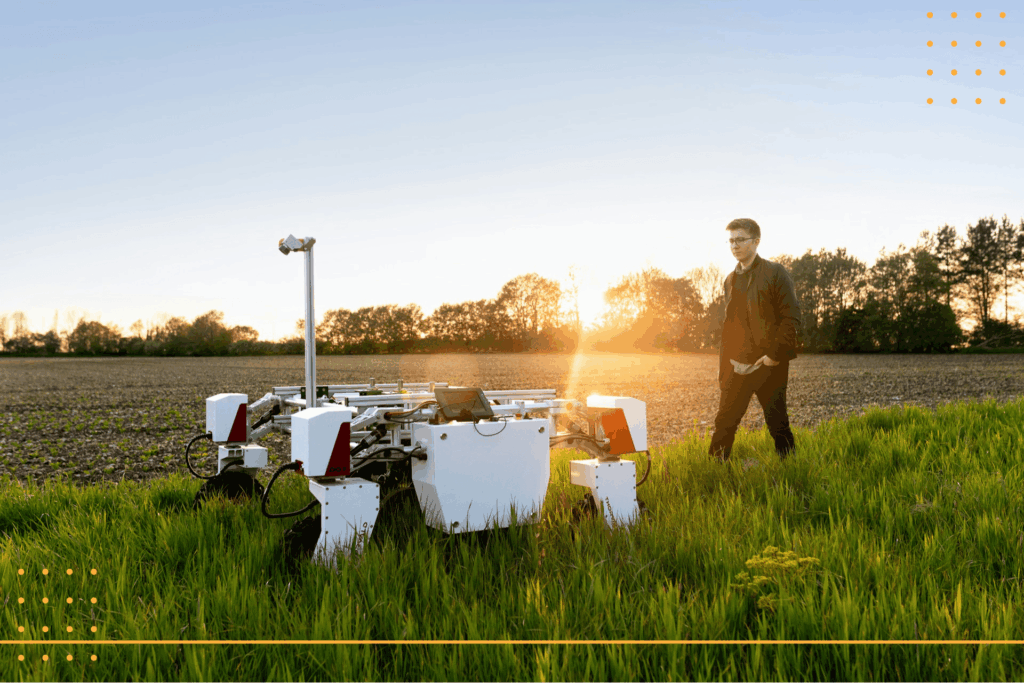
What happens if this remaining ten percent shrinks even further as a result of technological progress? We don’t even need to start dreaming of humanoid robots in the style of *Star Trek*—reality is already catching up with us in very practical ways. Think of autonomous commercial vehicles that transport materials to construction sites on their own, or specialized, AI-powered machines.
It is no longer a pipe dream to imagine an automated construction machine erecting a wall precisely according to a digital blueprint during a night shift, while the craftsman sleeps. The next morning, the foreman will only be responsible for quality control and final inspection. Whether we ultimately call it “artificial intelligence,” smart “workflows,” or automated agents—the technology will permeate the skilled trades. And it will do so much faster, more deeply, and more uncompromisingly than most businesses can imagine today.
A Look at the Feeds: When Fiction Becomes a Blueprint
Lately, I keep coming across fascinating videos on social media that explore precisely this intersection between technology and craftsmanship. Let’s not kid ourselves: some of these clips are purely AI-generated. But my point here isn’t to scrutinize the exact veracity of every single post. Rather, it’s about something much more fundamental: our mindset and our imagination. What flickers across the screen today as AI-generated animation could be an absolute reality on our construction sites tomorrow—or, realistically speaking, in perhaps five years. Who would have thought in the 1950s where we stand technologically today? We’re talking about a development that is no longer accelerating linearly, but exponentially. It is no longer just about short-term tech hype, but about a profound, rapidly growing change that is arriving at the heart of our society faster and faster every day.
The journey has begun: A look at the reality (and the vision)
To illustrate where we’re headed, I’ve compiled a selection of videos. Some already showcase real-world, highly advanced practical applications; others are visual thought experiments—AI-generated visions that show us what will soon be possible with a little imagination. They all share a central message: they challenge the status quo. Once we have achieved this level of technology across the board—and we will—only one uncomfortable question remains: Can the trades still claim that artificial intelligence is of no use in our industry?
Laboratory Conditions vs. Reality: A Look at the Evolution of Technology
Of course, we have to remain realistic: Many of the videos shown were created under sterile laboratory conditions (or using AI). The robots featured in them often have ideal, unobstructed space to maneuver—a luxury you’d search for in vain on a real, cramped construction site, in the winding basement of an old building, or in a labyrinthine attic. But these clips show only the very beginning. Let’s remind ourselves what the first car, the first computer, or the first airplane looked like, and how these technologies shape our daily lives today. That is precisely why I am firmly convinced that artificial intelligence will take over a massive portion of the individual tasks and subtasks in traditional trades.
I recently read a post on LinkedIn that I’d like to quote here—not as a criticism, but as a perfect example of the current mood in the industry. The author wrote: “If people who’ve never driven a nail in their lives try to convince me that artificial intelligence or robots will soon replace me, they really ought to spend a few weeks on a construction site.”
The boss is the last one to go:
And at this point, we should also consider who is saying such a thing. Often, it is the master craftsman and the owner of a small business themselves. This person will—purely mathematically—of course be the last to be replaced. But while a master craftsman might be on the construction site today with perhaps two journeymen and two apprentices, the day after tomorrow he’ll be there with three robots, while the AI in the office answers phone calls, schedules appointments, and writes invoices that the master craftsman only has to briefly review in the evening and which are then sent out automatically. The master craftsman has remained, but four tradespeople, one person on the phone, and one person in accounting have been replaced. If you’re the master craftsman yourself, that might be okay, but if you’re one of the 4–5–6 employees, perhaps not?!
Direct comparison is inaccurate:
On the other hand, it’s important to note that in the digital world, the “inventor” of a digital service doesn’t necessarily have to perform that service themselves. The “inventor” of self-driving trucks doesn’t need a commercial driver’s license, just as the founders of Flixbus don’t need a bus driver’s license to start a bus company. Of course, it always helps to have some knowledge of the subject matter, but in the digital world, disruptions don’t come directly from the industry itself. The founders of Uber and Lyft were probably never taxi drivers?! But they were “digital natives.”
AI doesn’t replace jobs—it replaces tasks
This skepticism within the industry is understandable, but it doesn’t tell the whole story. I, too, don’t believe that AI and robots will completely replace the skilled trades as a whole. But the way we work will change radically: perhaps the construction site of the future will suddenly operate with just two people instead of ten. Perhaps the heating team will soon consist not of two technicians, but just one—because a transport robot autonomously carries the heavy heating unit down to the basement, and the human simply connects it there. And this is done according to precise installation instructions that an AI has previously calculated without error. As autonomous trucks deliver the materials and robots unload them, the need for purely physical manpower is shrinking.
The golden rule of digitalization is: AI doesn’t replace jobs; AI replaces tasks.
If too many of these individual tasks can be automated in a specific role, the team shrinks. A ten-person operation becomes a two-person team, and the two-person team becomes a lone worker. At the same time, of course, the workload increases for the remaining positions.
Let’s take a look at the modern office: Thanks to computers and the internet, a single person can now handle tasks that used to require three to four times as many employees. Entire fields of work have been eliminated or merged. This is exactly what the skilled trades are facing. Anyone who doesn’t prepare now and adapt their workflows runs the risk of their entire job becoming obsolete at some point—not because the skilled trades are dying, but because they have become more efficient than we could ever have imagined today.
Conclusion: The mental barrier and the future subjunctive
So where do we stand at the end of these reflections? If we’re honest, we’re exactly where we started. This article deliberately uses the subjunctive—a space filled with “would,” “could,” and “might.” But when it comes to AI and automation, I am firmly convinced that the first and greatest barrier right now is our own imagination. As soon as we learn to break down complex processes into smaller steps and open our minds to the idea that AI can take over some of these individual tasks, the boundaries of what is possible shift. What is possible today—just think of the rapid developments in cloud-based AI agents—was barely conceivable six or twelve months ago, and pure science fiction ten years ago. So how can we reliably predict what will be reality in five, ten, or even fifty years? There will certainly always be areas where human improvisation and decision-making skills remain indispensable. But even this scope will become narrower. And that is by no means meant in a negative way.
Imagine how AI could help in the field of medicine. Specialists, for whom patients typically wait 6 to 12 months for an appointment, could increase their patient load from 40 to 400 per week thanks to AI-assisted diagnosis. Or, when visiting a cardiologist, AI might detect a lung tumor at the very back of the chest—slightly hidden—on an X-ray that a cardiologist would never have found. AI will not only take over direct tasks in every industry, but also create entirely new ones.
The plumber might set up a radar device in the middle of the room and, within 60 seconds, know the exact route of the pipe. To find a water leak in a pipe, it’s no longer necessary to tear down the entire wall; instead, an AI drone sent through the water line can pinpoint the leak’s location with 5-centimeter accuracy, potentially reducing the entire job from two days to two hours. The question isn’t what AI can do, but rather, what we can imagine.
A societal transformation: An opportunity to address the skills shortage
The bottom line is clear: AI will massively accelerate our work. Jobs will evolve; some will disappear, while new ones will emerge. However, the biggest mistake would be to immediately view the issue through a profit-driven lens and focus solely on budget cuts or staff reductions. In the office, the goal is to eliminate time-consuming routine tasks—and on the construction site, we must use AI and robotics to replace physically demanding, exhausting work. This may be a rosy, perhaps even naive view, but especially in light of the acute shortage of skilled workers, we must first see technology as a means of relief. Before we talk about replacing people, we must protect the people who are currently burning out in the system.
How do we keep tradespeople—who are physically worn out by age 50 or on the verge of burnout—mentally and physically healthy? The trades sector should embrace AI and robotics with open arms. It is the only way to address the skilled labor shortage in the long term and make the profession attractive again for the future—moving away from a purely backbreaking job that inevitably leads to early retirement.
The use of AI in the skilled trades does not portend a nightmare scenario, but rather a social responsibility and a transformation whose enormous potential we can only begin to imagine today.