
Blog article series – Please No Sales-Calls:
Part 1: The future of the marketing and sales funnel: how strategies need to adapt
How to become a frame of reference in your customers’ minds through strategic content.
Summary:
The numbers don’t lie – these are the facts about the modern buyer journey in Europe:
- 78.5% of deals in Europe go to the provider that the buyer contacted first (first contact advantage).
- In over 80% of cases, the first contact is initiated by the buyer, not by the sales department..
- The average member of a buying group goes through 620+ interactions (content, web, social) before making a decision.
- 70% of the buyer journey is already complete before the first contact with sales takes place.
- The average European buying center consists of 9.5 people.
- Ein typischer B2B-Kaufzyklus in Europa dauert im Schnitt 10 Monate.
- European buyers evaluate an average of 4 different suppliers during their search.
- 84% of buyers ultimately choose the brand toward which they already had a positive bias (winning bias) before beginning their active search.
- In 83% of technical purchasing processes, the IT department is involved as a key stakeholder.
- Prospective customers who obtain information through video content are significantly more likely to shortlist the provider (97% of technicians actively use video for research).
The illusion of control
„We have the market under control. Our sales team knows all the key players.“ Or alternatively: ”We have the market under control. We have known our customers for years and know exactly what they want.“ Or even more extreme: ”I have been CEO for 30 years, I know the market and my customers, I don’t need numbers.”
These phrases are often heard in the executive suites of companies that develop highly technical products that require a great deal of explanation. But as a marketing manager, I regularly see that this certainty is often a dangerous illusion. Control over the purchasing process has long since shifted from the supplier to the buyer — and this usually happens completely unnoticed in a phase I call the “digital cold”: where facts are compared without human warmth.
In the past, sales was the sole “gatekeeper” of knowledge. Today, the buyer journey is more emancipated than ever. Prospective customers in technical industries are research professionals. They use white papers, case studies, and video platforms to get a crystal-clear picture—long before they officially contact a company.
The “invisible” 620 interactions
The current 2024 European B2B Buyer Experience Report from 6sense shows just how intense this phase really is. Today, the average member of a purchasing group in Europe goes through over 620 interactions before making a final decision. In over 80% of cases, the first contact is now initiated by the buyer, not the seller.
The problem: if marketing only acts as a reactive “picture pusher,” supplier of trade fair brochures, or service provider for sales, this phase remains unused. While your sales team may believe that the game hasn’t even started yet, the customer is already in the second half. Those who are not present here with a strategic (marketing) system are leaving the field to the competition.
True value creation only arises when we stop viewing marketing and sales as isolated islands of knowledge. It is no longer about “capturing” the customer when they make an inquiry. It is about being present as a trustworthy partner through integrated systems, even in the anonymous research phase—and thus overcoming “digital coldness” through genuine relevance.
2. The “winning bias”: Why the first choice is usually the last
It is one of the most painful realizations for any sales manager: When the phone rings and a new prospect makes an inquiry about a complex technical project, the outcome is often already clear.
The figures from the 6sense study for the European market are clear: around 78.5% of buyers ultimately choose the provider they contacted first. In the US, this figure is even higher, at over 84%.
Conversely, this means that whoever wins the “first contact” almost always wins the deal. But how do you become that first point of contact, how do you become the “first contact”?
The trap of comparability and shortlist filters
In technical industries, marketing often only becomes “active” when it comes to generating leads for sales. But if you only show up when the customer is actively searching, you run the risk of getting stuck in the first filter. While 5 to 6 vendors are often loosely evaluated in the early research phase, this circle rapidly narrows down to a shortlist of only 2 to 3 companies that are even allowed to submit a bid.
Those who fail to build trust before this selection process ends up falling into the comparability trap: They are merely invited as a “second or third bid” in order to drive down the price of the actual favorite or to mirror technical specifications. The result is massive price pressure and a sales department that “can no longer turn things around” because it was called to the table too late. In this constellation, the offer no longer determines who wins the contract—it usually only confirms a decision that has long since been made in the customer’s mind. Welcome to the second division.
From challenger to favorite
However, the “winning bias” arises much earlier. It is the result of priming. When a decision-maker has been consuming your content for months—whether through in-depth case studies, strategic white papers, landing pages, newsletters, or relevant insights on LinkedIn—they develop a subconscious (and hopefully positive) bias. They trust your system even before they know your sales team—or the sales team gets to know the prospect.
As a strategic orchestrator, I know: We need to set up marketing in such a way that it carries the “sales DNA” into the anonymous phase. The goal is to create an integrated value creation system that ensures that you don’t just appear when the customer is looking for a solution, but are already anchored in the customer’s mind as an authority when the problem is first identified.
Those who rely on chance become followers. However, those who use strategic generalism to connect the dots between technical excellence and digital visibility secure their place as the “day one favorite” This is not marketing voodoo; it is applied sales psychology in a modern (marketing) system.
3. Technical content as a “reference framework”: Those who ask the questions lead the market
A common mistake in communicating technical products: Companies resort to purely feature-based performance descriptions. They talk about torque, tolerances, or processor performance. The problem with this? As soon as you start talking only about facts, you make yourself comparable. You are literally inviting customers to open an Excel spreadsheet and compare you with the competition.
True market leaders take a different approach. They use content not for self-promotion, but to occupy the frame of reference in the customer’s mind.
From provider to benchmark
Imagine a potential customer is in the anonymous research phase. They are not reading about how great your solution is, but rather what they need to look for when choosing a system in this area. You talk openly about:
- Typical mistakes made during implementation.
- Hidden risks that often only become apparent after two years of operation.
- The three critical questions he should ask every potential provider (including your competitors).
Something magical happens at that moment: You cease to be an interchangeable provider. You become a teacher and trusted advisor. When the customer later talks to your competitor, they will ask your questions and apply your quality criteria. You have marked the playing field.
The power of depth (and the video paradox)
The study “2024 State of Marketing to Engineers” shows us a clear direction here: 97% of technical decision-makers use videos for research. But—and this is where the wheat is separated from the chaff—they immediately tune out if the content remains superficial or the quality (especially the sound) is not right.
Technical marketing must not radiate “digital coldness.” It needs substance and passion. High-quality video content that delves deep into problem solving instead of just polishing the surface is the fuel for your integrated value creation system. Those who dare to share knowledge instead of hiding it behind a sales wall gain interpretive authority over the project even before the first official meeting takes place..
4. The new quality of sales meetings: From supplicant to consultant on equal footing
A common misconception is the concern that an emancipated, well-informed customer will make sales redundant. Or worse: sales are so confident that they think all they need to do is get the prospect on the phone once and the deal is in the bag. The opposite is true. The role of sales is changing fundamentally: it is shifting from being an information provider to a strategic closer.
In an integrated value creation system, where marketing has already overcome the “digital coldness” and set the frame of reference, the energy of every sales encounter changes—whether it’s a video call, an on-site appointment, or an industry event.
The end of basic calls
When prospective customers are pre-qualified through high-quality content, in-depth insights into use cases, and clear problem reflections, the first 30 minutes of the classic “getting to know you” phase are eliminated. Customers no longer ask questions such as, “What exactly can you do?” or “Why should I trust you?” These questions have already been answered by marketing during the qualification process..
Instead, you get involved right where the real value creation begins:
- Consulting instead of presentation: You no longer talk about the product, but about its specific integration into the customer’s processes.
- Security through expertise: Since the customer has already seen your videos or read your guides, a basis of trust already exists. Sales no longer has to laboriously build this trust; it only has to confirm it.
- Higher closing rate through relevance: The 6sense study shows that buyers prefer companies that understand their specific challenges as early as the research phase..
Synergy instead of silos
As a generalist, I consider every “touchpoint” – i.e., a contact between people – to be the moment of truth for the entire system. When marketing does the groundwork and sales converts these opportunities with its individual sales DNA, the result is an impact that cannot be achieved with conventional methods.
The sales department is relieved because it no longer has to chase “dead horses.” It can focus on prospects who have already accepted the frame of reference. The result is shorter sales cycles and conversations that feel less like a sales interrogation and more like a collaborative search for solutions.
This naturally also changes the requirements for sales. This depth of knowledge must be able to keep pace with the depth of the discussions.
5. Conclusion: Time for a new ranking
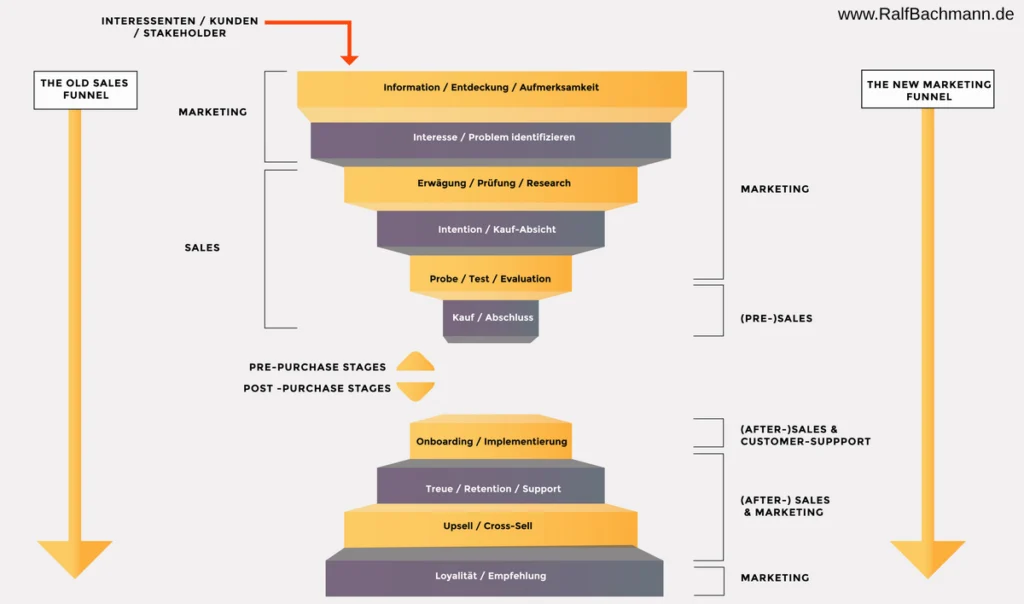
We must face reality: In a world where 80% of purchasing decisions are made before a human salesperson enters the picture, marketing is no longer a “support department.” It is the strategic spearhead of corporate management. The “New Marketing Funnel” (top diagram) clearly illustrates this. The shift in emphasis is clearly evident.
Anyone who still sees marketing as a reactive supplier of brochures and colorful pictures is leaving their market success to chance—and to competitors who are already set as “day one favorites.” The transformation from reactive administration to proactive value creation is not an option, but a survival strategy for any company with technical products that require explanation.
In doing so, we must face up to a harsh truth: Nowadays, bids no longer determine whether a contract is awarded. They often merely confirm a decision that has already been made. If the customer only contacts you to submit a bid without you having been part of their research journey beforehand, you are usually just a statistic for price comparison or the famous three comparative bids.
From image pusher to architect of the system
As a marketing generalist, my message is clear: We need a new ranking within the organization. Marketing must be directly subordinate to management and not only support sales, but also provide strategic guidance. The aim is to break down the silos between technology, marketing, and sales and create an integrated system that:
- Occupies the reference frame in the market.
- Clearly positions the company as the “Day One favorite” (“top of mind”).
- Overcomes digital coldness with genuine passion and relevance.
- Provides sales with pre-informed partners on equal footing rather than cold leads..
The next step
The figures from the 6sense study and the findings on the changing research behavior of technical decision-makers are a wake-up call. Companies that tailor their content precisely to this “new marketing funnel” not only achieve higher profit margins, but also secure a market position that can no longer be challenged on price alone..
The transformation from reactive administration to proactive value creation is therefore not an option, but a survival strategy for every company—not only those with technical products that require explanation.
Are you ready to take your marketing out of the supporting role and make it the director of your market leadership? The “New Marketing Funnel” won’t wait. It’s time to turn genuine passion into a measurable system..
CRM as the core of the marketing-sales process:
Of course, this raises a fundamental question for marketing managers: how can we make these 620 invisible interactions and the invisible majority visible? As a company, we cannot simply rely on hope.
On the one hand, we need to implement a controlling system that measures our marketing success. However, if we only start measuring when the customer calls us, we mathematically reduce the measurement basis to the 20 percent that is visible. This obscures our view of potential. This almost automatically results in the need to find a solution to make the invisible 80 percent visible.
A good CRM system can be an effective tool for this—including automation. CRM systems enable at least some of this 80 percent to be captured through GDPR-compliant tracking. We can enrich the CRM using various methods such as lead magnets, internal measurement systems, and customer records. In this way, the CRM identifies customers who visit our website, view our landing pages, write comments, download lead magnets, watch our videos, or interact with our content in any way.
Depending on the CRM, it is even possible to identify which company visitors come from based on their IP address. Technology has advanced to the point where we can learn a lot about a person even if they do not provide their name.
Although this may seem like stalking or spying at first glance, as long as it complies with the GDPR, we are operating within the scope of regular marketing, tracking, and controlling. This offers an exciting opportunity to find out more about the prospective customer: Which pages and specific subpages of our website do they visit? Which topics interest them? Which white papers do they download? And how should the prospective customer be addressed?
The accuracy of measurements varies from CRM to CRM, but there is definitely the possibility of making some of that 80 percent visible.
But beware of blind faith in technology: A CRM can only measure. Marketing must derive operational steps from this. Otherwise, it’s just dusty numbers on a server. Generalists in particular recognize the “big picture” here and manage to extract the key messages from a seemingly endless series of numbers and derive new marketing activities that are suitable for us..